Defer Background Images for Faster Core Web Vitals
Defer or lazy load background images for a faster Largest Contentful Paint

Defer background images
Background images are seldom a good thing for the Core Web Vitals. Background images are not responsive, background images cannot access the native loading attribute and we cannot natively control the priority of background images.
Background images will often cause issues with the Core Web Vitals. Deferring unimportant background images will in many cases improve your Largest Contentful Paint.
Last reviewed by Arjen Karel on February 2026
Table of Contents!
According to the 2024 Web Almanac's Performance chapter (the most recent edition with LCP element type data), 9% of mobile pages have a CSS background image as their LCP element. Of those, only 2% preload it. That means on roughly 1 in 11 websites, the most important image on the page is invisible to the browser's preload scanner and starts loading late.
Across sites monitored by CoreDash, pages where the LCP element is a regular <img> tag have a p75 LCP that is roughly 620ms faster than pages where the LCP is a CSS background image. The difference comes almost entirely from resource load delay: the browser discovers an <img> immediately via the preload scanner, but a background image has to wait until the CSS is downloaded and parsed.
All too often I see this anti-pattern including background images on websites. Especially on WordPress websites that use page builders like Elementor.
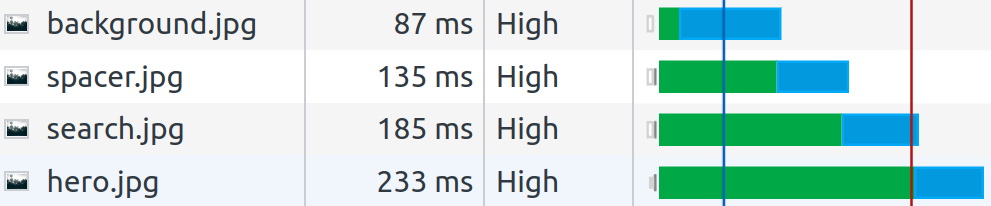
- All images, including the LCP image (the hero image) are lazy loaded
- Some image elements that are not really important (like a spacer, a search-box background etc) are linked as background images in a stylesheet
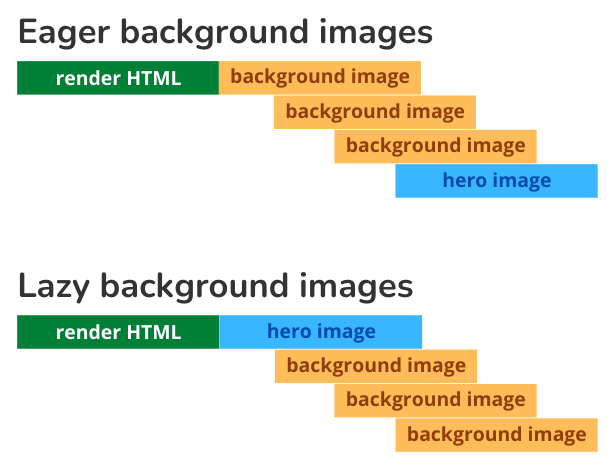
In this short article I will show you how to lazy load these background images in order to prioritize other, more important, images on the page.
A word of warning!
Let me start off with a word of warning! When the LCP element is delayed by background images mistakes have been made and you should preferably fix them the right way (preload the LCP image, do not lazy load the LCP image, avoid background images altogether). Unfortunately sometimes there is just too much legacy and you have no other short-term alternative than to patch the site up as best as you can. That is when you can apply a fix like I am presenting you here today!
Method 1: Defer everything
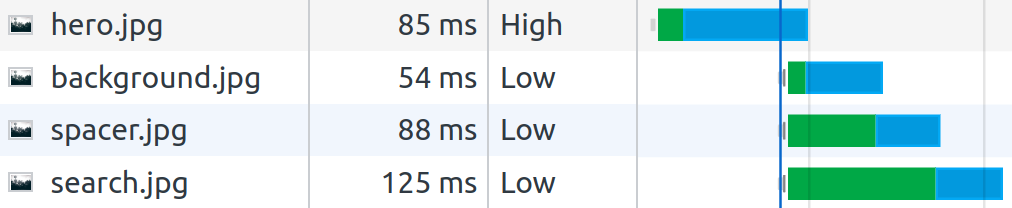
The defer everything method is just a barbarian way of doing things. But it is easy to implement, and it will work well to improve the Core Web Vitals! With this method all background images are deferred until the DOMContentLoaded event has been fired. This will give the browser a little bit of extra time to schedule the most important resources first.
Here are the steps involved: first we are going to overrule the background-image style property for all elements that have a background image. Once the DOM content has been loaded we are going to remove this override again. By that time the non-background images will be queued for download. This would be a great time to then enqueue the less important background images for download.
The code
First create a style and place it in the HEAD of the page. It is important that this style has an id because we are going to use this id to remove this style tag later on. Of course instead of the wildcard (*) you could also only add the CSS class names that actually have a background image.
<style id="no-bg-img">
    *{background-image:none!important}
</style>
Next, when the DOM content has been loaded, the LCP image will probably already be queued for download. At this point it is safe to queue the background images.
<script>
    window.addEventListener('DOMContentLoaded',function(){
        document.getElementById('no-bg-img').remove();
    })
</script>
If the LCP does not trigger for an early download this is probably because of JavaScript. In that case you could try to switch the 'DOMContentLoaded' for the 'load' event.
In testing by DebugBear, preloading a background-image LCP element cut the LCP from 3.4 seconds to 1.7 seconds. The resource load delay dropped from 75% of total LCP time to just 2%.
Method 2: Lazy load background images
The lazy load background images method is slightly more gentle, advanced and requires more of a personal touch.
It works as follows: first we are manually going to identify all the elements with a background image. We need to add a class name to those elements (.lazybg). Next we will observe these elements with the IntersectionObserver and once they are close to the visible viewport we are going to lazy load the background image.
The code
First create a style and place it in the HEAD of the page. This style looks similar to the previous style but instead of removing the background image property for all elements on the page we are just going to remove it for elements with a certain class name.
<style>
    .lazybg {background-image: none !important}
</style>
Next, when the DOM content has been loaded, we will start observing the elements that have a background image. When that element scrolls into the viewport we will remove the .lazybg class to trigger a background download.
<script>
window.addEventListener('DOMContentLoaded', (event) => {

  // all elements with background images that should be lazy loaded
  const lazyImages = document.querySelectorAll('.lazybg');

  // options for the observer
  const backgroundOptions = {
     threshold: 0,
     rootMargin: "0px 0px 50px 0px"
  };

  // the observer
  const imageObserver = new IntersectionObserver((entries, imageObserver) => {
     entries.forEach(entry => {
         if (entry.isIntersecting) {
             showImageBackground(entry.target);
             imageObserver.unobserve(entry.target);
         }
     });
  }, backgroundOptions);


  // observe each image
  lazyImages.forEach(image => {
     imageObserver.observe(image);
  });

  // show background image
  function showImageBackground(node) {
     node.classList.remove('lazybg');
  }
});
</script>
The advantage of this method is that background images that are not in the visible viewport are not queued for download. This frees up resources for the browser during the loading stage. For more techniques like this, see how to defer offscreen images.

Conclusion
Both methods are effective in deferring the background image in favor of more important images like the Largest Contentful Paint image. The first method is real easy to implement and gets quick results. The second method adds real lazy load behavior to background images and will provide a bigger PageSpeed boost.
Be careful when applying any of these methods. If you need to defer background images your page is what I like to call 'slow by design'. The preferred method of fixing this would be to rewrite your pages and avoid the use of background images.
Find out what is actually slow.
I map your critical rendering path using real field data. You get a prioritized fix list, not a Lighthouse report.
Get the audit
